
Imagine building a successful business or amassing significant wealth over a lifetime. Now, imagine the uncertainty: What happens to it all? How do you ensure it's not fragmented by future disputes, eroded by taxes, or mismanaged by heirs? For centuries, families turned to complex trusts. Today, there's a modern, codified, and often more intuitive solution: the RAK ICC Foundation. This isn't just another legal structure; it's a legacy architect, designed to protect your assets and execute your vision for generations to come
The RAK International Corporate Centre (RAK ICC), through its Foundations Regulations, 2019, has established a best-in-class legal framework for asset management, wealth protection, and succession planning. In an era of increasing global financial complexity, foundations have emerged as a preferred structuring vehicle for entrepreneurs, high-net-worth individuals (HNIs), family businesses, and international investors. They offer a unique blend of corporate robustness and trust-like flexibility, providing a sophisticated mechanism to preserve wealth and ensure its seamless transition across generations.
A RAK ICC Foundation functions as an independent legal entity—a juridical person—that holds and manages assets for a specific purpose or for the benefit of designated beneficiaries, distinct from its founder.
1. What is a RAK ICC Foundation?
A foundation is a legal entity established by a Founder who endows it with assets. These assets are then managed by a governing body according to the specific objectives and rules defined in its two constitutive documents: the Charter and the By-laws.
Objects and Permitted Activities:
• A foundation can have charitable, non-charitable, or mixed objects.
• Prohibition on Commercial Activity: A key restriction is that a foundation may not carry out any commercial activities, except those that are "necessary for, and ancillary or incidental to, its objects." This means a foundation cannot operate as a trading business itself, but can hold and manage the shares of companies that do.
• Amending Objects: The objects can only be amended if an express power exists in the Charter or by Court order under specific circumstances (e.g., objects are fulfilled, impracticable, or no longer suitable)
Key Distinction from a Company:
• No Shareholders: Unlike a company, a foundation does not have shareholders or members who own equity. It is an ownerless entity.
• Purpose-Driven: It operates based on the Founder's stated objectives, which can range from pure wealth preservation for a family to philanthropic goals.
• Asset Ring-fencing: It holds assets independently of the Founder's personal estate, creating a legal firewall.
Under the RAK ICC Foundations Regulations, 2019, the foundation possesses full legal capacity and can:
• Own, buy, and sell property (movable and immovable).
• Hold and manage shares in companies, both onshore and offshore.
• Enter into contracts and conduct business activities aligned with its purpose.
• Manage diverse investment portfolios, including stocks, bonds, and alternative assets.
• Act as a partner in a partnership.
2. Legal Framework under RAK ICC Foundations Regulations, 2019
The RAK ICC Foundations Regulations, 2019 provide a comprehensive, modern, and internationally compliant statutory basis for establishing and operating foundations. This legal framework ensures certainty, transparency (where required), and significant flexibility for founders. The regulations meticulously detail:
• Formation and Registration: The process for incorporation, the required documentation (Charter), and the role of the RAK ICC Registry.
• Governance and Management: The structure, powers, duties, and liabilities of the Council, the foundation's governing body.
• The Guardian: Provisions for appointing a Guardian to oversee the Council and ensure adherence to the Founder's intentions.
• Asset Protection: The legal separation of assets and the framework for creditor protection, subject to robust anti-fraud provisions.
• Rights of Beneficiaries: The extent to which beneficiaries can enforce the by-laws or challenge council decisions.
• Reporting and Compliance: Annual filing requirements and mechanisms for amendments, mergers, or dissolution.
Scenario: A multi-jurisdictional family office manages a collection of assets for a single family, including a luxury hotel in Europe, a manufacturing unit in Asia, and a financial portfolio in the US. The family seeks a single, robust legal vehicle to centralize ownership and streamline governance.
Solution: The family establishes a RAK ICC Foundation. This single entity holds the shares of the various underlying holding companies (e.g., a BVI company for the hotel, a Singapore company for the manufacturing unit). The foundation's Council, comprising family members and trusted advisors, then provides centralized strategic oversight, ensuring a consistent governance structure and simplifying compliance across different jurisdictions.
3. Key Participants in a RAK ICC Foundation
The foundation structure relies on clearly defined roles and responsibilities to ensure its smooth and compliant operation.
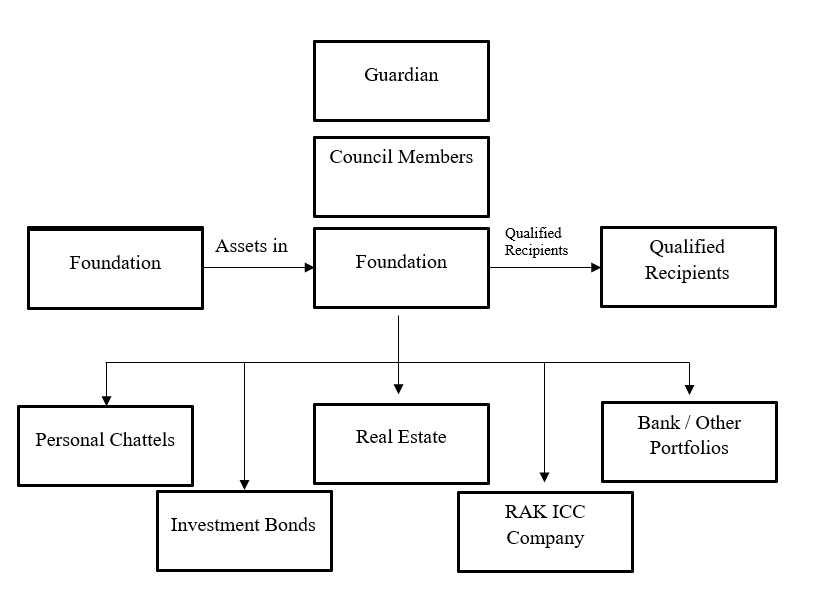
The Founder
The Founder is the individual or legal entity that establishes the foundation by signing the Charter and endowing it with initial assets. The Founder determines the foundational blueprint, including:
• The foundation's purpose (e.g., to hold the family business, provide for descendants, support charitable causes).
• The initial and future beneficiaries.
• The composition and powers of the Council.
• The rules for amending the Charter and By-laws.
• Whether to appoint a Guardian and defining their powers.
Scenario: A tech founder wishes to separate her operating company from her personal wealth and plan for her children's future.
Foundation Objective: She establishes a foundation with a multi-faceted purpose: (1) to hold the intellectual property and shares of her tech company, (2) to provide a monthly stipend to her parents for life, and (3) to fund university education for her children. The By-laws can prioritize these objectives and provide detailed rules for their execution.
The Council
The Council is the governing body of the foundation, analogous to a board of directors in a company. It is responsible for the day-to-day and strategic management of the foundation. Its fiduciary duties include:
• Managing and investing the foundation's assets with the care of a prudent person.
• Making decisions regarding asset allocation, acquisitions, and disposals.
• Ensuring strict compliance with the Charter, By-laws, and applicable laws.
• Determining the timing and amount of distributions to beneficiaries, within the framework set by the Founder.
• Keeping proper accounts and records.
Scenario: A foundation holds a controlling stake in a successful logistics company. The company receives a lucrative takeover offer.
Council Action: The Council must deliberate on the offer. They must consider the Founder's stated purpose (e.g., "to maintain the company as an independent family enterprise") and the long-term benefit for the beneficiaries. They may decide to reject the offer to preserve the family legacy or accept it and reinvest the proceeds into a diversified portfolio, depending on the By-laws. They are required to document their decision-making process to demonstrate they have fulfilled their fiduciary duties.
The Guardian
A Guardian is an optional but crucial oversight role. Appointed by the Founder, the Guardian acts as a supervisor to ensure the Council administers the foundation in accordance with the Founder's intentions as expressed in the By-laws. The Guardian provides an independent check on the Council's power and may have powers such as:
• Approving certain major decisions (e.g., amending the By-laws, removing a council member).
• Receiving information and accounts from the Council.
• Applying to the court to remove a council member for cause.
Scenario: A founder appoints his three children to the Council. To ensure a power balance and adherence to his wishes, he appoints his long-trusted family lawyer as the Guardian.
Guardian's Role: If two of the children on the Council vote to make a distribution that benefits themselves but arguably contradicts the founder's broader intent for wealth preservation, the Guardian can step in, review the decision, and potentially veto it if the By-laws grant that power. This prevents deadlock and protects the founder's original vision.
Beneficiaries
Beneficiaries are the individuals, groups, or entities entitled to benefit from the foundation's assets or income. The Founder enjoys immense flexibility in defining the beneficiary class:
• Fixed Beneficiaries: Those with a defined, enforceable right to a specific benefit (e.g., my eldest son shall receive an annual income of Rs.50000 /-).
• Discretionary Beneficiaries: Those who may receive benefits at the sole discretion of the Council, within a defined class (e.g., "my descendants").
• Conditional Beneficiaries: Those who receive benefits only upon meeting certain conditions (e.g., upon graduating from university, or reaching a certain age).
Charter and By-laws: The Foundation's Constitution
Every RAK ICC Foundation is governed by two essential documents that form its legal constitution.
Charter (Public Document)
The Charter is the foundation's public face. It is filed with the RAK ICC Registry and contains the essential information that defines its legal identity. It typically includes:
• The foundation's name (which must end with "Foundation").
• The address of its registered office in RAK ICC.
• The purpose or objectives of the foundation (can be broad, e.g., "to hold and manage assets for the benefit of the Founder's family").
• Details of the initial endowment (the initial assets transferred).
• The name and address of the Founder(s).
• The names and addresses of the initial Council members.
• The initial guardian (if any).
By-laws (Private Document)
The By-laws are the internal rulebook of the foundation. This is a private, confidential document that is not filed on any public register. It contains the detailed operational and governance rules, including:
• Detailed provisions for the appointment, removal, powers, and decision-making procedures of the Council (e.g., quorum, voting majorities).
• Investment policies and restrictions.
• Detailed rules for the distribution of income and capital to beneficiaries.
• Procedures for amending the By-laws.
• The role and specific powers of the Guardian.
5. Asset Protection Benefits
The primary driver for many founders is the robust asset protection offered by a RAK ICC Foundation. This protection stems from the fundamental legal principle of separate legal personality.
Once assets are validly transferred to the foundation:
• Legal Ownership Transfers: The assets are no longer owned by the Founder; they are owned by the foundation.
• Legal Separation: They are held in a distinct legal entity, completely separate from the Founder's personal estate.
• Creditor Protection: This separation generally shields the foundation's assets from claims by the Founder's personal creditors, provided the transfer was not made with the intent to defraud existing creditors (under applicable insolvency or fraudulent conveyance laws).
6. Succession Planning for Family Businesses
For family-owned businesses, succession is often the single greatest threat to long-term survival. Without a robust plan, businesses can be fractured by inheritance disputes, forced sales, or a lack of capable leadership. RAK ICC Foundations offer a powerful solution by creating a permanent, stable ownership structure.
The founder can transfer ownership of the business (company shares) to the foundation. The By-laws then act as a "family constitution," establishing clear, binding rules for the future.
7. Foundations as Holding Structures
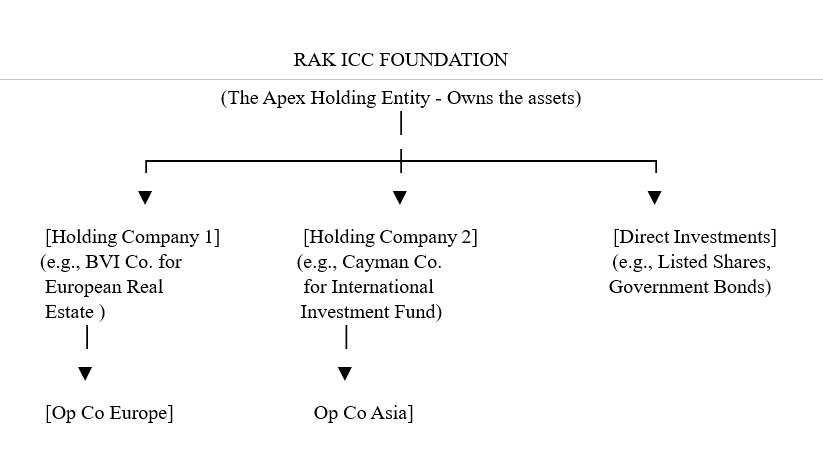
RAK ICC Foundations are exceptionally versatile and are widely used as the apex holding vehicle in complex international structures. This provides a clean, efficient, and centralized ownership layer.
They can legally hold a diverse range of assets:
• Company Shares: In onshore UAE companies, free zone entities, or international offshore companies (e.g., in BVI, Cayman).
• Real Estate: Direct ownership of property or indirect ownership via property-holding companies.
• Investment Portfolios: Managed by professional investment managers.
• Intellectual Property: Patents, trademarks, and copyrights, allowing for centralized licensing and royalty management.
• Family Businesses: As detailed above.
Example of a Typical Holding Structure-
RAK ICC FOUNDATION
(The Apex Holding Entity - Owns the assets)
Conclusion
The RAK ICC Foundations Regulations, 2019 provide a world-class, robust, and exceptionally flexible legal framework for wealth protection, succession planning, and long-term asset management. By empowering founders to establish a separate legal entity with a clear purpose, a structured governance mechanism, and the ability to define beneficiary rights with precision, RAK ICC Foundations have become a premier structuring tool for family offices, entrepreneurs, and international investors navigating a complex global landscape.
With their strong legal foundation in a respected UAE jurisdiction, combined with robust confidentiality provisions, and unmatched flexibility for both private and philanthropic purposes, RAK ICC Foundations represent a modern, effective, and durable solution for managing, protecting, and preserving wealth across generations.
© 2026 Business Consultant & Law Firm - Legacy Partners. All Rights Reserved.
Designed by Nuewelle Digital Solutions LLP

Legacy Partners
We typically reply in a few minutes