
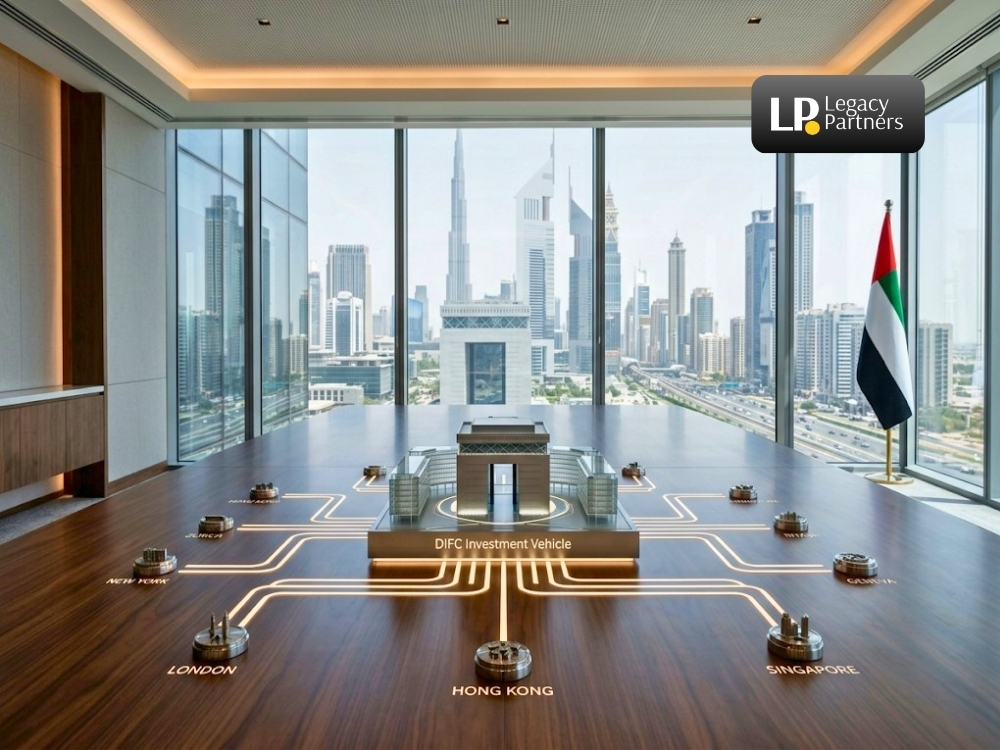
The Dubai International Financial Centre (DIFC) is one of the world's leading financial free zones and the premier hub for banking, finance, fintech and professional services across the Middle East, Africa and South Asia. For international businesses seeking a credible, tax efficient and globally connected base, establishing a presence in the DIFC offers a compelling combination of full foreign ownership, an independent common law legal system, and access to a dense ecosystem of financial institutions. This article explains the key benefits of setting up in the DIFC and what they mean for your business.
DIFC at a Glance
| Jurisdiction | Dubai International Financial Centre (DIFC), an independent financial free zone in Dubai, UAE |
|---|---|
| Regulator | Dubai Financial Services Authority (DFSA) |
| Legal system | Independent common law framework based largely on English law, with its own DIFC Courts |
| Foreign ownership | 100% permitted, no local partner required |
| Corporate tax | 0% on qualifying income for up to 50 years |
| Official language | English (legal and business) |
| Best suited for | Banks, asset managers, insurers, fintech, family offices, holding companies and professional services |
100% Foreign Ownership
One of the most significant advantages of the DIFC is that it allows 100% foreign ownership of your business. Unlike many mainland UAE structures, there is no requirement to appoint a local Emirati partner or sponsor. This gives international founders and corporations complete control over their operations, profits and strategic decisions, making the DIFC particularly attractive for global firms establishing a regional headquarters.
Attractive Tax Regime
The DIFC offers a highly competitive tax environment. Qualifying entities benefit from a 0% corporate tax rate on qualifying income for up to 50 years, and there is no personal income tax for employees. Crucially, there are no restrictions on the repatriation of capital or the transfer of profits, allowing businesses to move funds freely across borders. These benefits are subject to meeting the qualifying conditions set out under the UAE's corporate tax framework, and businesses should obtain tailored tax advice on their specific structure.
Independent Common Law Legal System
The DIFC operates under its own independent legal and regulatory framework based largely on English common law distinct from the UAE's civil law system. It has its own court system, the DIFC Courts, which adjudicate in English, as well as an internationally recognised arbitration centre. For businesses and investors familiar with English law, this delivers a predictable, transparent and enforceable legal environment that reduces commercial and contractual risk.
Robust and Internationally Respected Regulation
Financial services firms in the DIFC are regulated by the Dubai Financial Services Authority (DFSA), an independent regulator whose standards are aligned with leading global benchmarks. This strong regulatory reputation enhances credibility with clients, counterparties and correspondent banks, and supports firms in meeting the compliance expectations of international investors and partners.
Strategic Location and World Class Ecosystem
Situated in Dubai, the DIFC sits at a strategic time zone crossroads between the financial markets of Europe and Asia, bridging the trading day between London and the Far East. Beyond geography, the centre offers a dense and mature ecosystem: a concentrated cluster of banks, asset and wealth managers, insurers, law firms, auditors and consultants, alongside a thriving DIFC Innovation Hub that supports fintech and high growth technology companies. This proximity creates valuable opportunities for partnership, talent and deal flow.
Access to Talent and Streamlined Visas
The DIFC provides streamlined employee visa sponsorship and access to a deep, multilingual pool of international professionals drawn to Dubai's quality of life and tax position. This makes it easier for firms to recruit and relocate the specialist financial, legal and technology talent they need to scale.
World Class Infrastructure
Businesses in the DIFC benefit from Grade A office space, modern dispute resolution facilities, and a well developed business support environment spanning banking, professional services and lifestyle amenities. This high quality infrastructure allows firms to operate efficiently and present a premium, credible front to clients and investors.
Points to Consider
While the advantages are substantial, businesses should weigh a few trade offs. Operating and licensing costs in the DIFC are generally higher than in some other UAE free zones, reflecting its premium positioning. In addition, DIFC entities typically cannot trade directly within the mainland UAE market without additional licensing or arrangements. Understanding these factors early helps ensure the DIFC is the right fit for your business model.
Ready to establish your business in the DIFC?
Legacy Partners provides end to end support for DIFC company formation, licensing, regulatory compliance, and corporate advisory.
Contact Legacy Partners today for a personalised consultation. info@legacypartners.ae
Frequently Asked Questions
Updated On: 09 Sep, 2026