
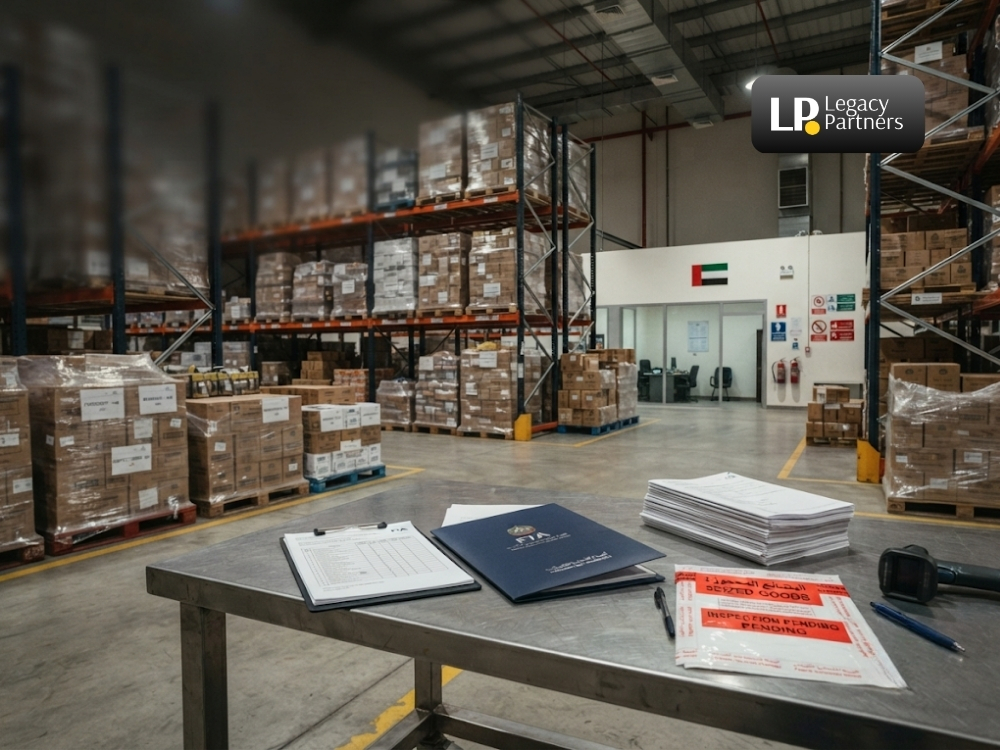
A new rulebook for goods the FTA holds
On 11 June 2026 the Federal Tax Authority issued Decision No. 7 of 2026, setting out how it stores, moves, sells and disposes of seized and abandoned goods. The Decision takes effect on publication in the Official Gazette and sits under Federal Decree Law No. 28 of 2022 on Tax Procedures and its Executive Regulation, Cabinet Decision No. 74 of 2023.
For businesses holding excise or dutiable stock, the message is direct. Goods held by the Authority are no longer stuck in limbo. Where they are perishable or unsafe, they can be valued, auctioned and converted into cash that is applied against your tax bill.
Which goods the Decision covers
Article 2 limits the scope to seized or abandoned goods that are:
- perishable in nature
- subject to shortage or leakage
- in a condition that might endanger other goods or the facility storing them
Ordinary durable stock is outside this Decision. The rules exist so the Authority is not left warehousing goods that will spoil, evaporate or create a hazard.
Storage and movement controls
Article 3 obliges the Authority to preserve the condition, quality and quantity of seized goods so they can either be returned to the owner or valued for sale. In practice this means approved storage locations, government vehicles or an appointed service provider for transport, stocktaking records before, during and after movement, periodic condition reports and security access logs.
That trail matters to you. If your goods are released, those records are the reference point for any dispute over quantity or condition.

When the FTA can sell your goods
Under Article 4, a sale requires a Committee decision and all four of these conditions:
- The goods are perishable, subject to shortage or leakage, or dangerous to the facility or surrounding environment.
- The owner or representative has not requested retrieval after settling the full tax, administrative penalties and related expenses, or has exhausted or waived the right to retrieve them.
- The goods still hold value and have not deteriorated beyond use.
- The goods are legally permitted to be sold and circulated in the UAE, unless they are sold for export.
Where the goods relate to an investigation or pending legal proceedings, the Authority must first obtain approval from the Public Prosecution or the competent court.
The public auction process
Article 5 sets the mechanics. The Committee decides on the sale, and the owner or representative is then notified of the decision, the reasons and the date. The Authority contracts a licensed auction service provider, working to Committee criteria covering the reserve price, auction method, payment and delivery terms, participation rules, announcement mechanism and the treatment of incomplete auctions.
Once sold, the goods pass to the buyer and the Committee issues a sale certificate proving completion and transfer of ownership. The Authority carries no liability for the use or circulation of the goods afterwards. Where goods cannot legally be sold locally and are sold for export, the buyer must give the Authority proof of export.
Where the money goes
Article 6 sets a strict payment waterfall for auction proceeds:
- Auction, storage and movement costs
- Tax due from the taxpayer
- Administrative penalties due from the taxpayer
- Any balance credited to the taxpayer's tax account, once the right to retrieve the goods is exhausted
If the owner waives the right to recover the balance, the Authority may take it into its own revenues. Note the ordering: costs come off the top, so the recovery credited against your tax position is the net figure, not the hammer price.
What businesses should do now
- Keep excise and customs records current so goods are never treated as abandoned by default.
- Respond immediately to any seizure notice. The clock on retrieval rights runs whether or not you act.
- Budget for the full settlement amount. Retrieval requires tax, penalties and related expenses to be paid in full, not partially.
- Track designated zone and warehouse stock closely, particularly short shelf life goods, which fall squarely within Article 2.
Facing a seizure notice from the FTA?
Our consultants can walk you through retrieval rights, settlement amounts, and the auction process. Email us at info@legacypartners.ae to get started.
Frequently Asked Questions
Updated On: 14 Sep, 2026